
A 27B model on a laptop can read raw neural network weights and name the game they play
Simon Willison reran a viral test on Qwen 3.8 27B. Given only floating point numbers, it identified Pac-Man, Pong and Breakout, after about an hour of thinking each.
 DevIsDead Newsroom
The paper everyone was arguing about this week claimed frontier models can read and even edit neural network weights directly, a practice its authors call Weight-Space Programming. Simon Willison wanted to know if a model he can run at home could do the first half. It mostly can, he writes on his weblog.
The test
The paper, by Rikiya Takehi, Omar Khattab and two co-authors, trained four small networks to play simplified grid versions of Breakout, Pong, Pac-Man and Freeway. It then gave the raw weights, as plain floating point numbers, to an LLM and asked which game the network was trained on. No tools, no code, no calculator, one response. The authors say GPT-6 Astra handles this and much more.
The prompts are public on GitHub, so Willison pointed his LLM command-line tool at them and ran them against Qwen 3.8 27B in LM Studio on his laptop. It's a 17GB model that he says feels close to the best proprietary models of 2025. He had to raise the context window above the default and extend the timeout.
The results
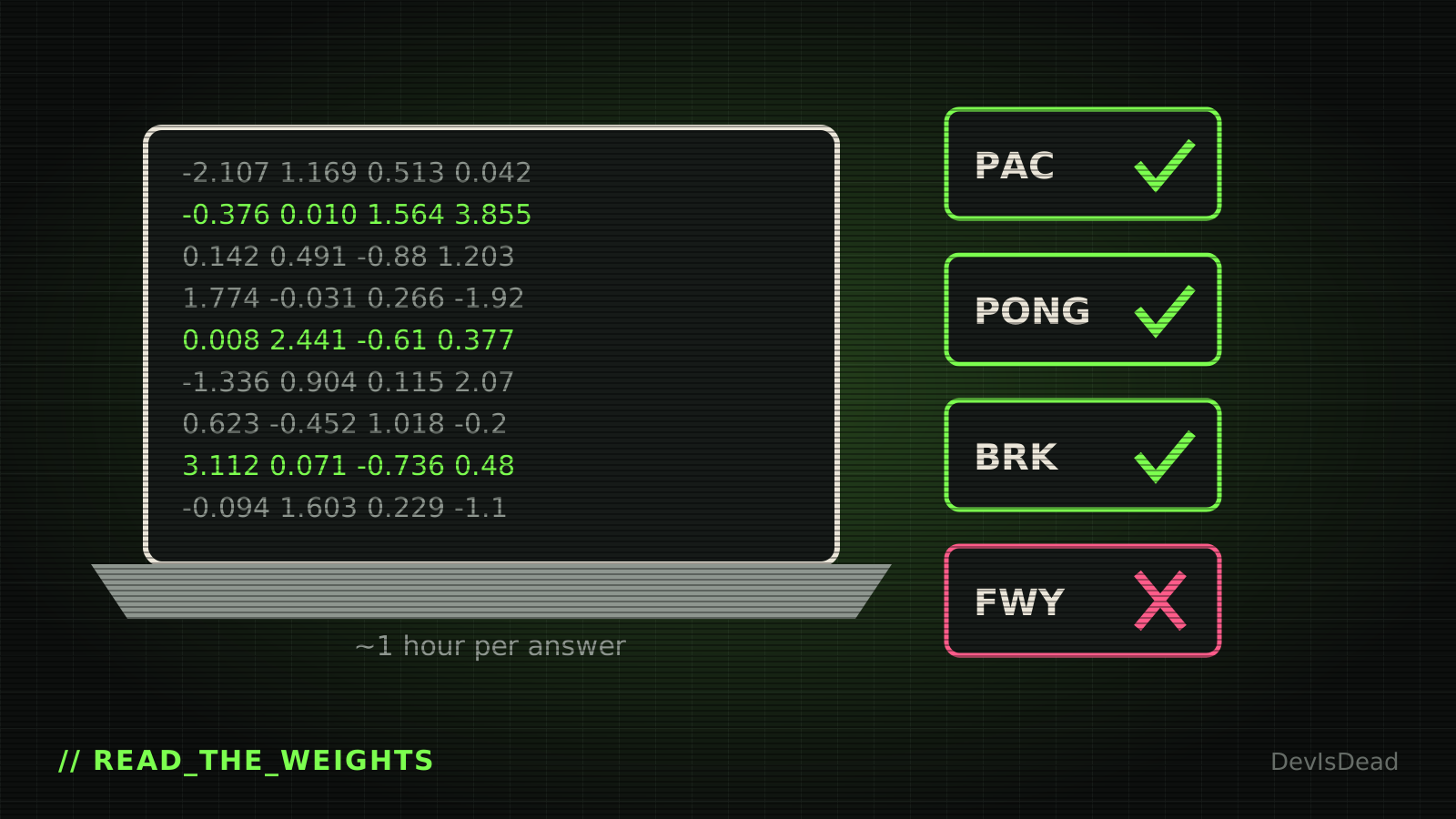
- Pac-Man: correct, 72% confidence, after 46 minutes and about 43,500 reasoning tokens.
- Pong: correct, 75% confidence, after just over an hour.
- Breakout: correct, 88% confidence, after 52 minutes.
- Freeway: wrong. Qwen guessed a Pac-Man-like game, which Willison wasn't surprised by, since the 1981 Atari title is more obscure.
Kimi K3.1 Pro, run through OpenRouter, got Breakout in under ten minutes. The reasoning traces are mostly unreadable lists of rows, channels and weight values. Willison found them fun to skim anyway.
Benchmarks vs. vibes
Willison keeps his enthusiasm in check. He thinks an experienced human with a notepad, a pencil and enough patience could probably get to the same answers. He also separates two claims the paper mixes: reading weights without tools, and editing models once a model has code to run. Critics including spaCy's Matthew Honnibal called that mix misleading, and Sean Goedecke argued the paper's headline model-repair example follows the same steps a human ML researcher would take.
His conclusion is the one to keep: cool result, overblown commentary. He's not ready to say source code is over or that machines will soon edit their own weights in ways we can't follow.
Still, three out of four on a laptop is a striking data point. A capability that showed up as a frontier-model party trick now runs on consumer hardware, if you're willing to wait an hour.
Scoreboard update: AI +1. A laptop model reads raw weights and correctly names three of four games.
Stay undead.

Comments 0