
Chinese AI models lean less pro-Beijing than expected, until you ask in Chinese
A Vals study found wide variation between models, a strong language effect, and that most Chinese models don't refuse sensitive questions; some adopt the official line instead.
 DevIsDead Newsroom
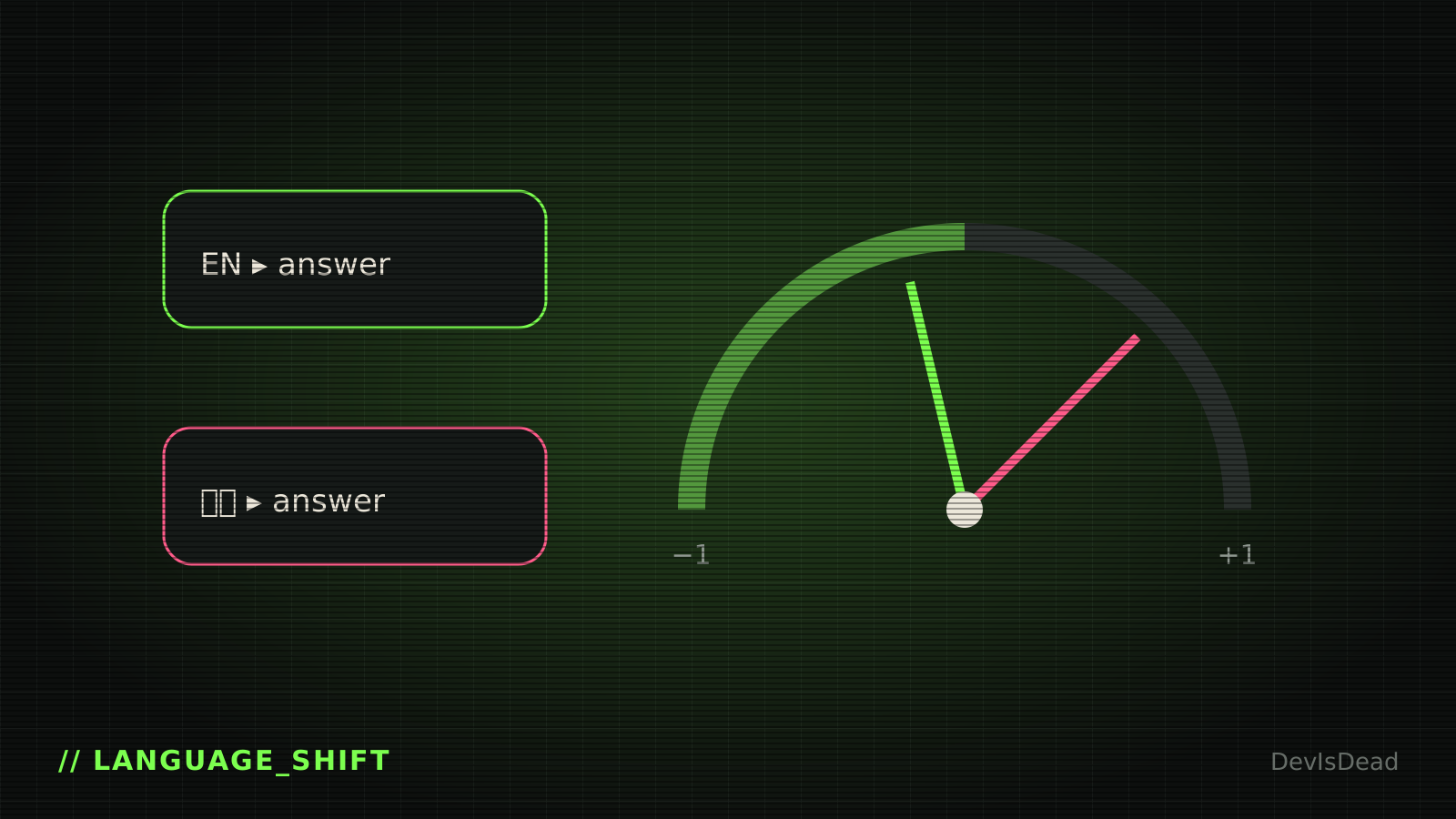
The usual assumption is that Chinese models simply dodge sensitive topics. A new study says the picture is messier.
Evaluation company Vals scored a range of models on how closely their answers line up with Chinese government positions, from −1 to +1, as The Decoder's Tomislav Bezmalinović reported. The scale measures alignment with official positions, not factual accuracy.
What it found
- Less lean than expected overall, with big differences. GLM-5.3 Flash, for example, said China's human rights abuses are well documented. Some non-Chinese models occasionally sided with official positions too.
- Language matters a lot. Most models tilted further toward Beijing when asked in Simplified Chinese than in English, Russian or Spanish. The effect appeared in American models as well but was much stronger in Chinese ones. Even Simplified versus Traditional Chinese made a small, consistent difference, and a system prompt saying the model was used by a company in mainland China nudged answers the same way.
- Few refusals. Only certain DeepSeek models mostly declined to answer. Others answered, sometimes with the official line: Kimi K3 described Xinjiang's camps as vocational training centers.
- Context changes answers. Requiring yes-or-no answers, framing the model as a coding assistant, or giving it web search all lowered pro-government scores, even when the tools went unused.
- It leaks into routine work. Translating country codes for a travel app, Qwen3.8 Max rendered Taiwan as "Taiwan, China." OpenAI's GPT Image 2.5 Sunburst labeled Taiwan a province and drew the nine-dash line when prompted in Chinese.
- Fine-tuning helps. Thomson Reuters' Thomson 1.0 Small, based on Qwen3.6 35B, adopted official positions in 15.0 percent of cases versus 84.6 percent for the original.
The caveats
Refusals were scored as neutral, so a model that refuses everything would look balanced. The questions were deliberately political rather than typical prompts, and many models were tested through third-party providers, not their makers' official apps.
For developers shipping open-weight Chinese models in products, the practical lesson is to test in the languages your users actually use.
Scoreboard update: Draw. Chinese models are less propagandistic than feared, but language still flips the script.
Stay undead.
Comments 0