
Huang's affair with a suspected Chinese informant undercuts Nvidia's fight against tighter chip export rules
A Malaysian Megaspeed affiliate reportedly bought at least $4.8B in Nvidia hardware. With Democrats taking over committees in January, stricter controls look more likely.
 DevIsDead Newsroom
Jensen Huang spent years arguing that Nvidia should keep selling AI chips to China. The scandal around him has made that argument much harder to win, Maximilian Schreiner reports for The Decoder, drawing on Bloomberg.
The scandal, briefly
Huang acknowledged in a company-wide memo an extramarital relationship with Alice Huang, also known as Huang Le, a former executive at Singapore data center operator Megaspeed International. US intelligence agencies consider her a suspected informant for Chinese intelligence, and Secretary of State Marco Rubio reportedly warned senior officials about the relationship in a memo. As recently as late October, Huang described it to Bloomberg as "normal." China's embassy denies the espionage claims. As we reported, Nvidia's board has opened an independent investigation.
Why Megaspeed matters
Megaspeed runs data centers across Southeast Asia and sells compute to companies including Alibaba. US authorities suspect it's a back door for moving export-controlled Nvidia chips into China; a Malaysian sister company reportedly bought AI hardware with at least $4.8 billion of Nvidia chips between June 2024 and February 2026.
It's part of a wider leak. Billions of dollars of Nvidia chips reach China through Southeast Asian smuggling networks despite the bans. Nvidia has tightened tracking: its Fleet Intelligence system logs where accelerators are and is now required for its regional cloud partner status, though sharing location data with Nvidia or the government is voluntary. It also cut half its pre-approved Asian buyers and capped resale of compute to Chinese firms at 50%. Washington considers that insufficient; Nvidia says it follows the law and that catching illegal actors is the government's job.
The politics
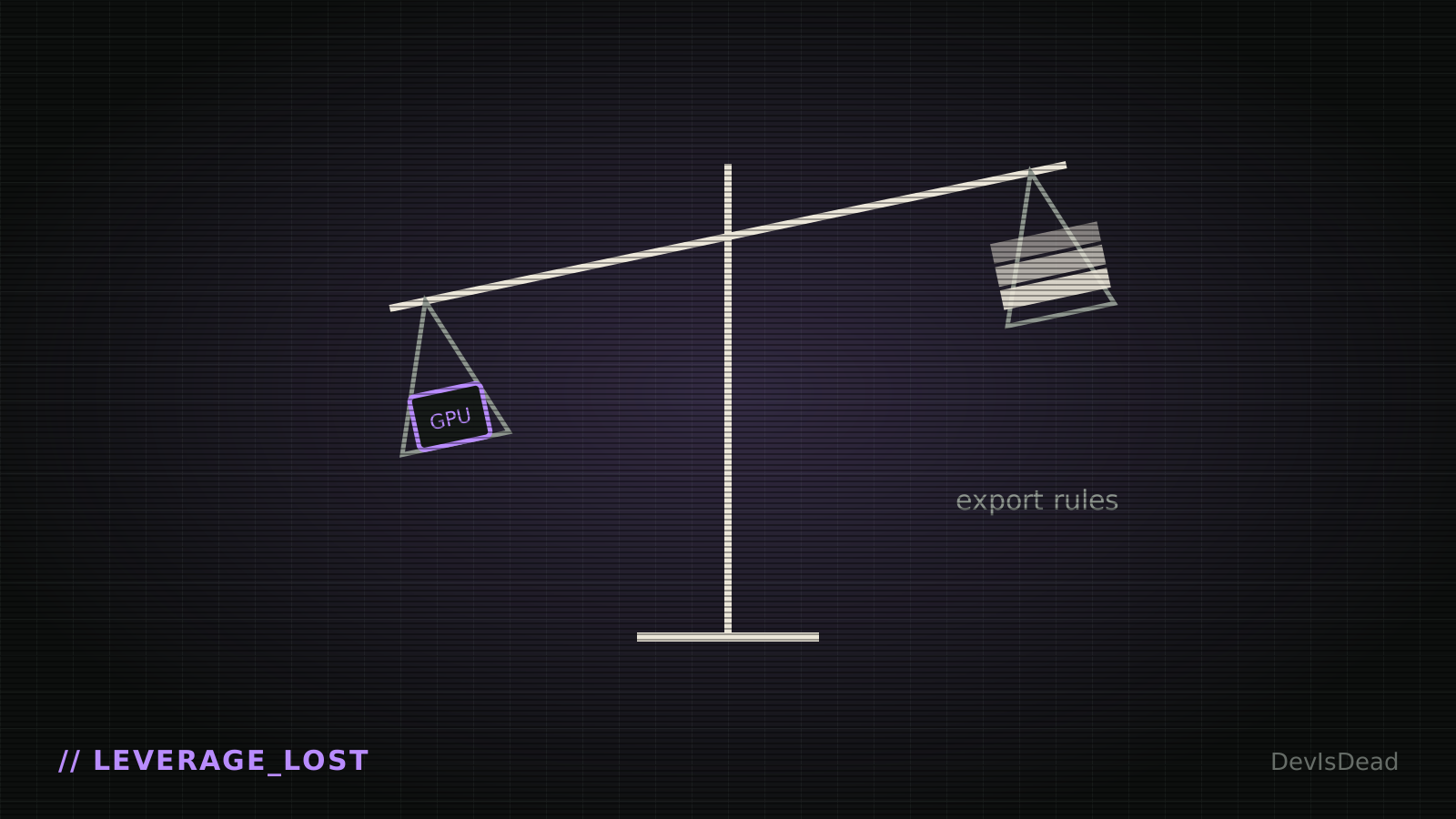
Huang's case was that shutting China out would push it to build its own, possibly better, AI industry. He made it directly to the Trump administration and joined Trump's May trip to Beijing. Now, with Democrats controlling both chambers and taking committee chairs in January, Bloomberg Intelligence says the affair weakens Nvidia's hand just as Congress plans to scrutinize chip exports more closely.
There's also the succession question. Nvidia is worth about $4.5 trillion, roughly 60 people report directly to Huang, and there's no public succession plan. Bernstein's Stacy Rasgon says Huang "is Nvidia." He owns just under 4% and, unlike Zuckerberg, has no dual-class shares to protect him.
Scoreboard update: Humans +1. Chip export hawks gain ground as the industry's chief lobbyist becomes the story.
Stay undead.
Comments 0