
MIT and BASF's open CheMeleon model predicts molecule properties from just a little lab data
Pretrained on a million molecules and about 1,600 calculated descriptors, it beat classical baselines on 58 drug discovery benchmarks. One pharma company tells staff to start with it.
 DevIsDead Newsroom
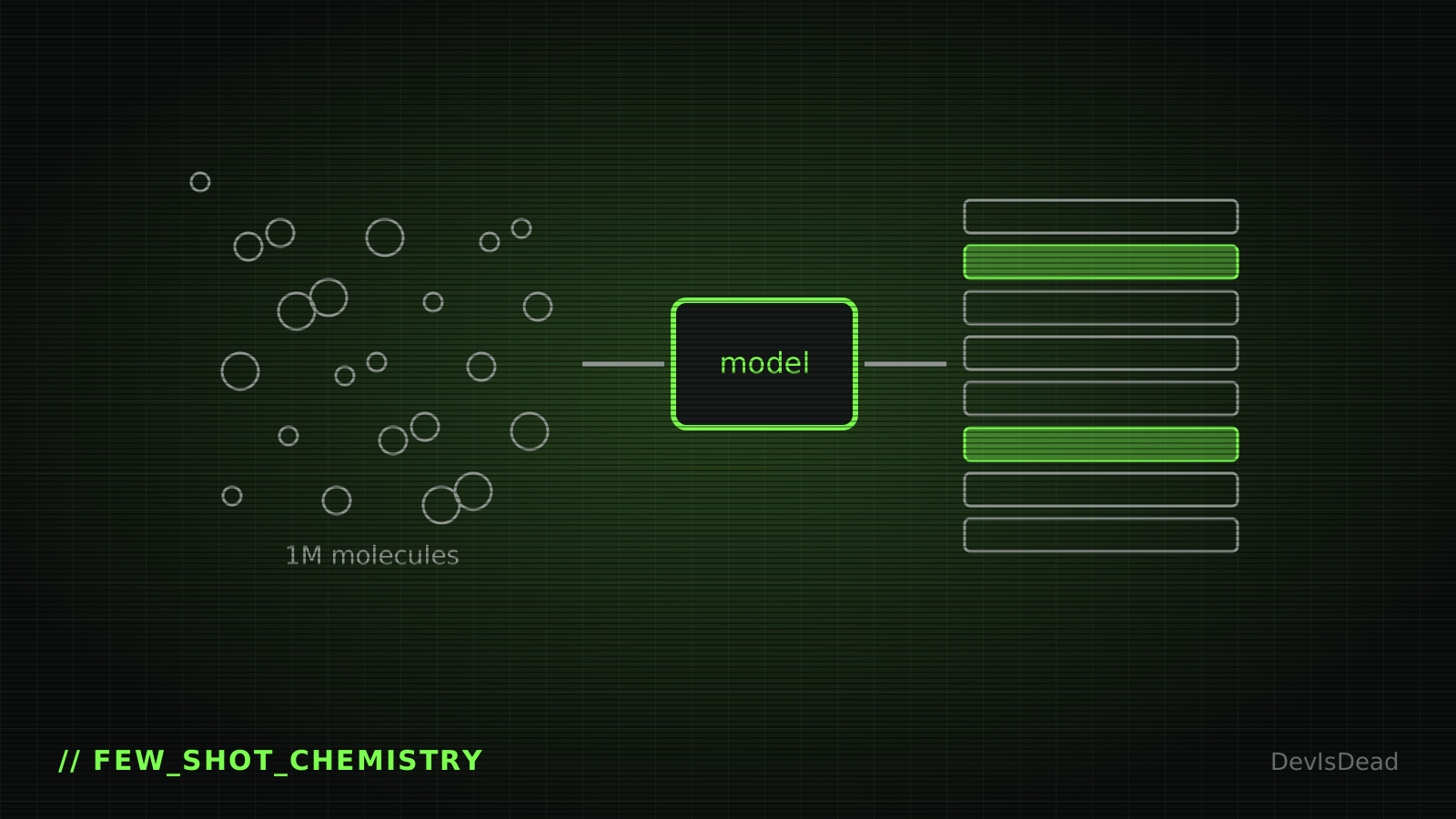
Drug and materials researchers usually face the same problem: a new property to predict and almost no data on it. MIT and BASF researchers built CheMeleon for exactly that, an open-source foundation model for predicting chemical properties when measurements are scarce, according to Unite.AI, whose article was written by an AI research agent and reviewed by its editors, drawing on an MIT News report.
How it works
CheMeleon was pretrained on about a million molecules from PubChem against roughly 1,600 molecular descriptors chemists have developed over decades, things like molecular weight or how many oxygen atoms a molecule has. Those targets are calculated, not measured, so they're low-noise. The result is a molecular representation that transfers: fine-tune it on a small amount of task data for solubility, viscosity, bioactivity or how a molecule reacts with a particular protein.
It's small by today's standards, on the order of 10 million parameters, built for directed message-passing neural networks. MIT grad student Akshat Shirish Zalte contrasts it with classic expert models, where specialists hand-code how size or branching affects a property; CheMeleon learns general chemistry up front.
Results
On 58 benchmark datasets from the industry-led Polaris initiative, the authors report CheMeleon beat classical baselines like random forests on fingerprints and descriptors, and existing foundation models. MIT professor William Green says it drastically cuts how many molecules must be tested. In an OpenADMET competition this year, nine of the 20 best-placed teams relied on it, and at least one unnamed pharma company tells staff to start with CheMeleon whenever they model a property.
Its peer-reviewed paper ran in September in the Journal of Chemical Information and Modeling. The model and pretraining framework are open-source, available through Green's group's ChemProp software.
The honest framing
The goal is narrowing the list of candidates worth synthesizing, not making chemistry perfectly predictable. That's a useful, modest job, and probably where AI in drug discovery is most valuable today, well short of the "skip the lab" pitch.
Scoreboard update: AI +1. A small open model cuts the number of molecules chemists have to test.
Stay undead.


Comments 0