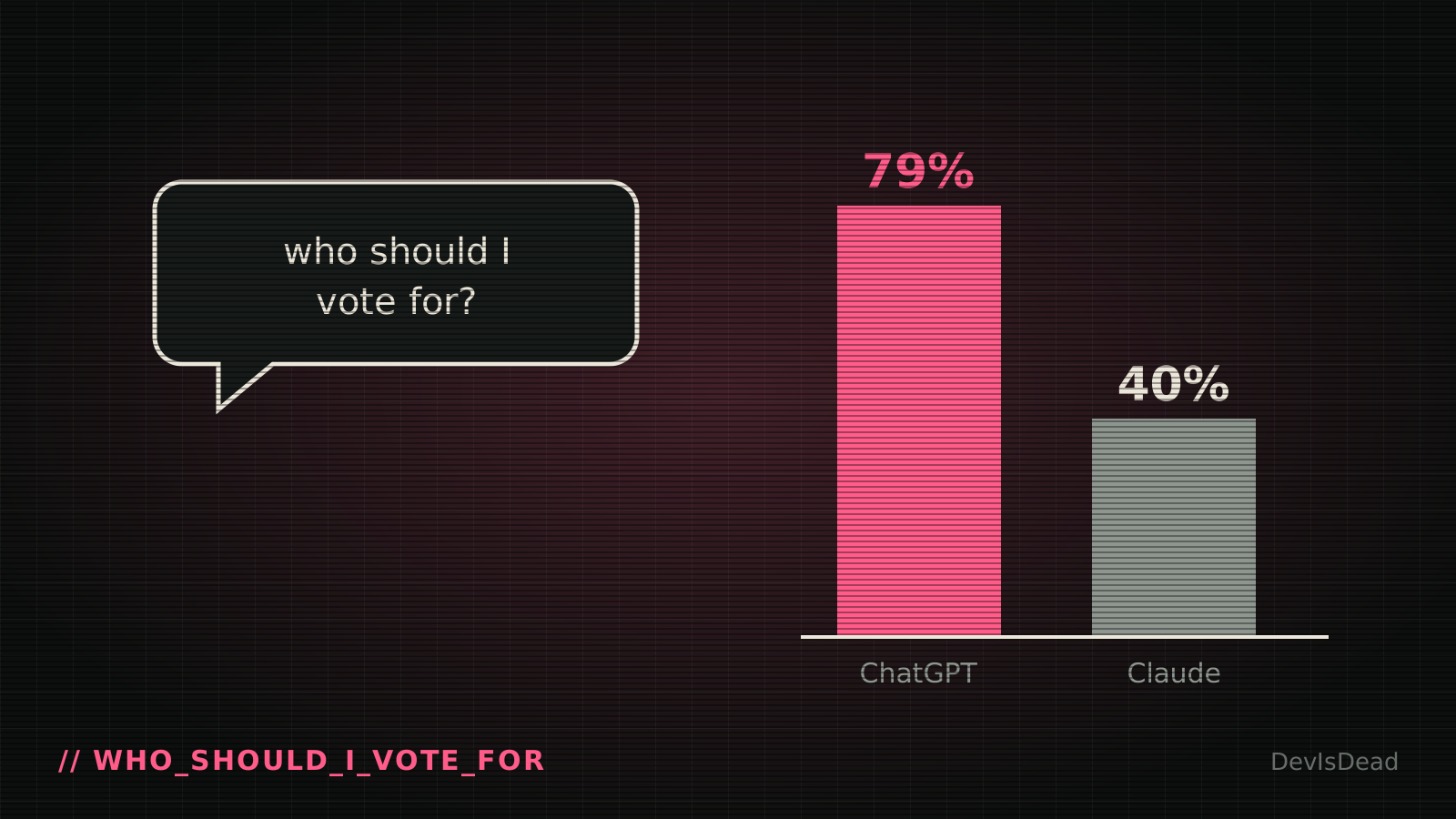
Once voters shared their views, ChatGPT picked a candidate for them in 79% of chats
Yale researchers had about 2,500 voters ask ChatGPT, Claude, Grok or Gemini about the midterms. A third wanted help choosing, and the bots answered very differently.
 DevIsDead Newsroom
Chatbots were on the campaign trail this year, at least as advisers. Researchers had nearly 2,500 people, spread across the 35 states holding Senate races, put election questions to ChatGPT, Claude, Grok or Gemini, and Radhika Rajkumar walks through the results for ZDNET. The Yale study ran for a few weeks in October, with adults who already use chatbots every week.
What people asked
Most questions were basics, like who's on the ballot. That's the safer category, since the web is full of accurate data on who is running where.
Still, 36% wanted a chatbot's help choosing a candidate, usually by laying out their priorities and asking who fit. That's harder, and the answer leans heavily on sources: a candidate's own website is better evidence than an opponent's clip of them.
How the bots answered
The models behaved very differently. When the user hadn't said anything about themselves, only Grok regularly named a candidate, in 14% of chats. Once users shared their views, ChatGPT made a recommendation 79% of the time, Claude 40% of the time, and Grok and Gemini fell somewhere in the middle.
The researchers also saw the conversation steering the result. In longer chats, users answered the chatbot's own questions, and those answers fed straight into its pick. What a model asks shapes what it hears, and what it ends up suggesting.
How big is this?
Still fairly small. Pew found 42% of US adults use chatbots to look things up, but only 8% used them for election information this cycle. Of that group, 76% wanted candidates' positions and 71% were fact-checking claims. Anthropic, looking at 250,000 Claude conversations in October, found 0.51% were about elections or voting, and that people seldom asked whom to vote for.
The risks are familiar. Chatbots still summarize unreliably, and most people don't click through to the sources. One study caught AI platforms giving outdated or wrong voting logistics. An August Brennan Center study found chatbots pushed back well on some election falsehoods, but readily produced misleading election images and video.
What makes this study useful is that real users asked their own questions, instead of researchers running a fixed script. Next, the team says, comes checking how accurate and balanced the answers were, and whether the recommendations matched what users actually needed.
For anyone building on these models: the gap between 79% and 40% is a product decision, not a law of nature. Somebody chose it.
Scoreboard update: AI +1. A third of chatbot-using voters asked AI to help pick a candidate, and ChatGPT usually obliged.
Stay undead.

Comments 0