
Potential Sciences wants to skip drug lab work by simulating molecules from physics up
The UK startup, backed by the government's SovAI fund, will generate synthetic chemistry data to train drug-predicting AI. Chemists say the hard part, testing in living things, still remains.
 DevIsDead Newsroom
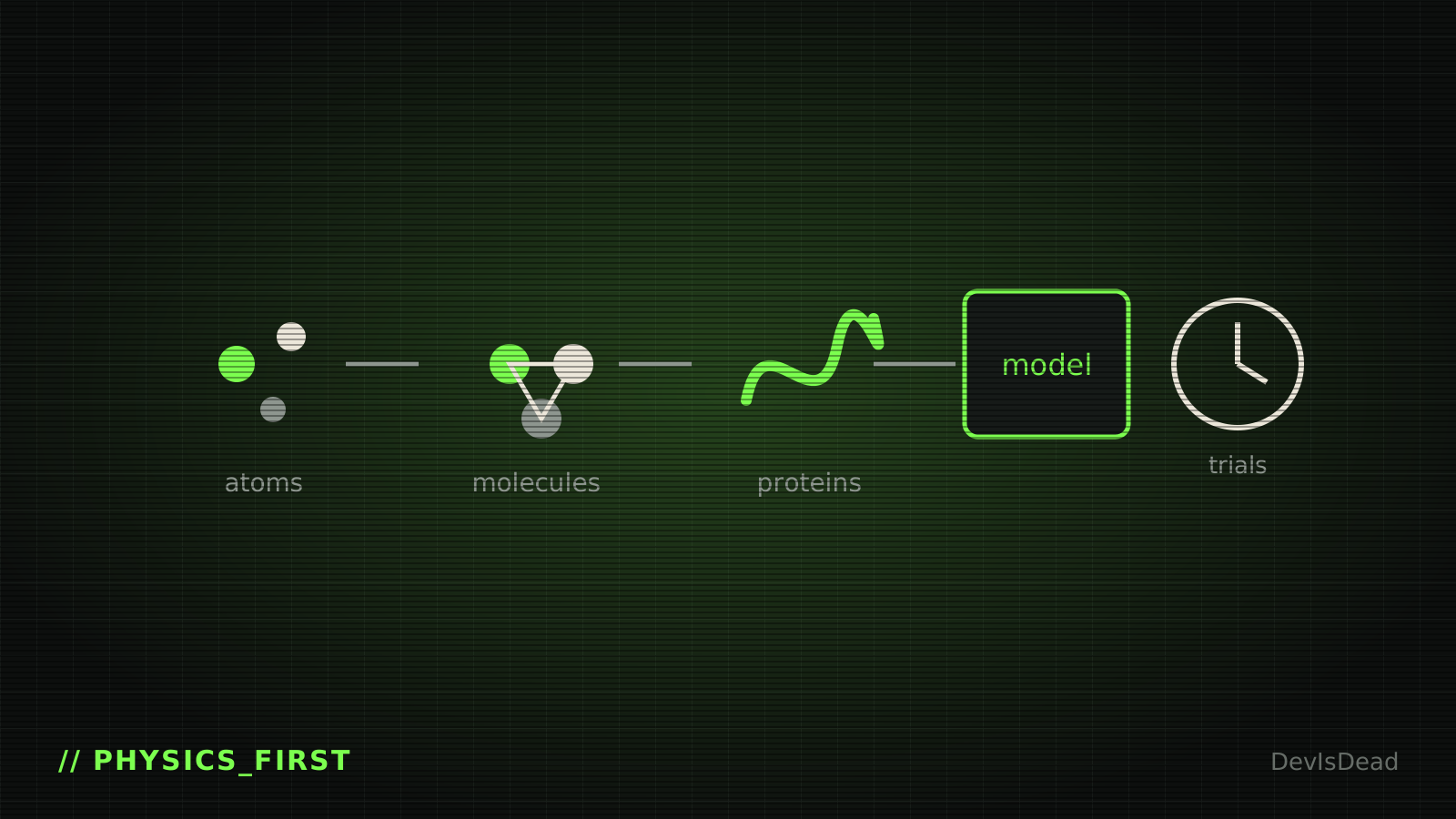
A new British startup thinks the bottleneck in AI drug discovery is data, and that physics can make more of it. Potential Sciences launched on November 5 with a seed round worth tens of millions of dollars, Joel Khalili reports for WIRED. The UK government's AI venture fund, SovAI, and Twin Path Ventures are among the backers; the founders wouldn't give an exact figure or valuation.
The plan
Founder and CEO Hatem Helal says much of the field trains on one public source, the Protein Data Bank, built up over decades of experiments, and that it's too small to train models good enough to reliably speed up drug discovery. Potential Sciences wants to build far bigger datasets synthetically: simulate interactions from first principles, starting with atoms, then small molecules, then amino acids and proteins, and train prediction models on the result.
The goal is to predict how candidate drugs will behave in the body well enough to kill bad ones early. Helal frames it as a search problem across an astronomically large space of possible molecules. Cheaper experimentation, he argues, could also make drugs for rare diseases worth pursuing, and eventually enable treatments tailored to an individual's biology.
SovAI, set up this year with about $800 million plus time on Britain's national AI supercomputer, also backs Isomorphic Labs, Basecamp Research and materials startup CuspAI. Its head of ventures, Joséphine Kant, has joined the board.
The skeptics have a point
Chemists like the approach but doubt the timeline. Cambridge's Alan Fersht says accurately calculating every molecular interaction in a cell would revolutionize drug development, and he's optimistic it will eventually happen. Rice University's Peter Wolynes says protein engineering today is more Roman than Renaissance, and points out that designing a drug is cheap next to finding out what it does to mice and patients. Faster candidate discovery doesn't shorten clinical trials.
There are open questions, too. The startup hasn't decided how it will make money, or whether to release its models freely, given that a tool that minimizes toxicity can be flipped to maximize it, as Helal himself acknowledges.
It's also a crowded field. Plenty of startups and labs are attacking the same bottleneck from other angles.
Scoreboard update: Draw. AI promises to skip the lab bench, but the clinic still sets the pace.
Stay undead.

Comments 0