
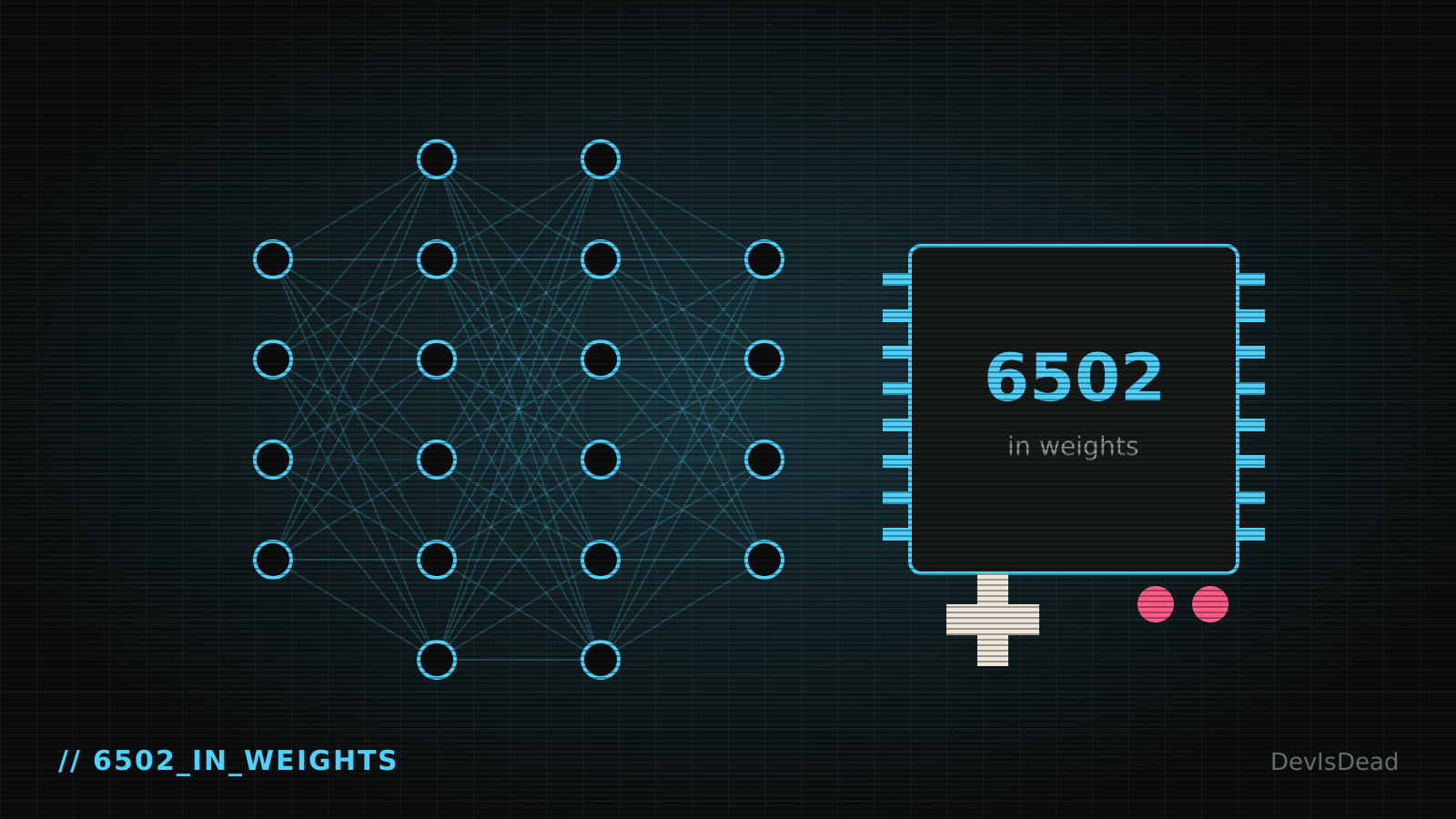
Someone put a NES CPU inside a 4B-parameter model. Mario runs. Slowly.
Drew Breunig built a working 6502 emulator into the weights of Qwen3.5-4B, with Claude Opus 5.5 doing much of the legwork.
 DevIsDead Newsroom
Today's most gloriously useless use of a language model: running Super Mario Bros inside one.
As Simon Willison flagged on his blog, Drew Breunig has built nesformer, which encodes a working emulator of the Nintendo Entertainment System's 6502 CPU directly into the weights of Qwen3.5-4B. Point it at a NES ROM and it plays, very slowly. The project was inspired by Divyansh Agrawal's qwenputer.
How it got built
In a Hacker News comment, Breunig shared the prompts he gave Claude Opus 5.5. The first asked it to read the qwenputer write-up and code, then figure out whether the same technique could emulate the NES chip and memory, and how big a model it would take. The second was basically: let's build it, just for fun, speed optional, with weights and a CLI that runs a ROM. Along the way, Opus found and used a set of NES CPU conformance tests that Christopher Pow published 15 years ago.
Why it's more than a party trick
It shows two things at once. Model weights can hold exact, deterministic computation, not just fuzzy text prediction. And a two-prompt brief plus a good test suite is now enough for an agent to carry a weird research idea to a working demo. The old conformance tests did the real work of keeping it honest. Test suites: still not dead.
Scoreboard update: AI +1. Opus builds a NES CPU inside model weights from two prompts.
Comments 0