The US AI safety center was reportedly asked to report to the White House, raising independence fears
CAISSI tests frontier models for cyber and bioweapon risks on a $10M budget with no permanent director. Critics worry its findings could be softened; others see more clout.
 DevIsDead Newsroom
The small federal office that tests AI models for national security risks may be losing its distance from politics. Staff at CAISSI, the federal center that tests frontier AI, were recently told to start reporting, informally, to an office in the White House, according to an Associated Press report summarized by Unite.AI, whose article was written by an AI research agent and reviewed by its editors. Two former officials described the request anonymously; the office wasn't named, and it isn't a formal reorganization.
What CAISSI is
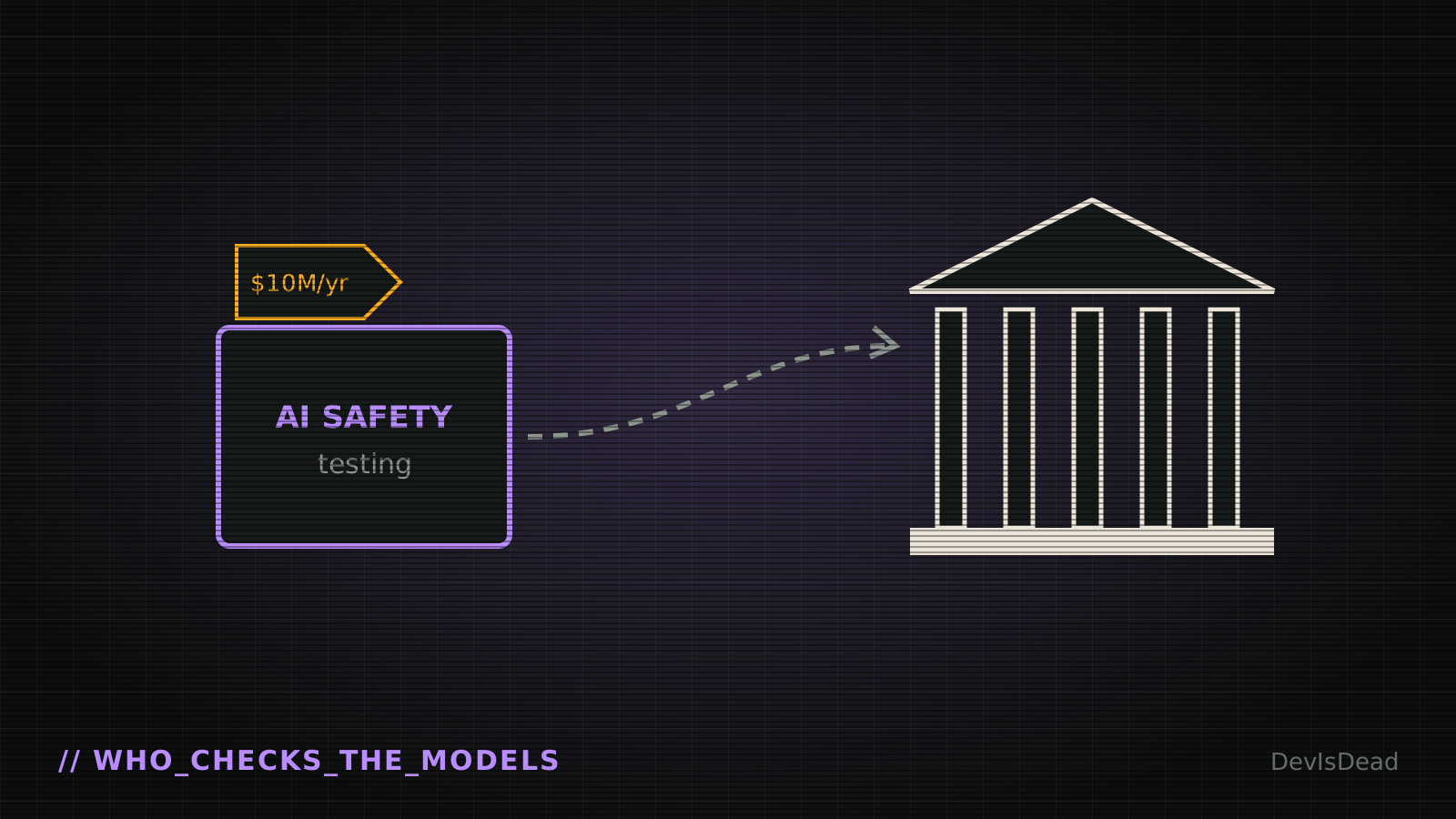
It's an independent division of the Commerce Department, until recently called the US Center for AI Standards and Innovation. Its job includes voluntary standards and agreements with AI developers, unclassified evaluations of cyber, bio and chemical weapon risks, and checking adversaries' models for backdoors. It gets about $10 million a year, roughly an eighth of its British counterpart's budget.
It's also been unstable. A director appointed in April was fired within days; the replacement resigned after a few months. The head of its parent institute is acting director. In August, Congress asked why it had stopped publishing reports on how safely AI systems were performing.
The worry
Critics say a White House line could politicize findings on cybersecurity and bioweapons, softening them for an industry largely trusted to police itself. Caroline Siegel Singh, who works on emerging tech at the Federation of American Scientists, wants policy made by technical experts outside party politics. Others say closer ties to the president could bring the office more prominence and money.
The backdrop matters. Trump asked leading AI companies in September to self-police through a voluntary safety pact, without saying how it would be monitored. A June executive order set up voluntary pre-release government access to frontier models and explicitly rules out mandatory licensing. Company-run and company-hired evaluations fill the gap, but labs can restrict those evaluators' access and set their findings aside.
Berkeley's Sayash Kapoor points to the next problem: there's no standard way to test how safely agents act, and judging only the end result can hide a huge mistake made along the way.
With testing voluntary, underfunded and now possibly politically supervised, the question of who checks the models has fewer good answers than it did a year ago.
Scoreboard update: AI +1. The government's AI safety referee gets pulled closer to the White House and further from independent.
Stay undead.
Comments 0