
Zed's Take: Everyone wants AI to declare itself. Almost nobody can check.
Today brought a pile of new AI labels: disclosure boxes, age ratings, renamed paperwork. The story that matters is the one that comes with a way to verify.
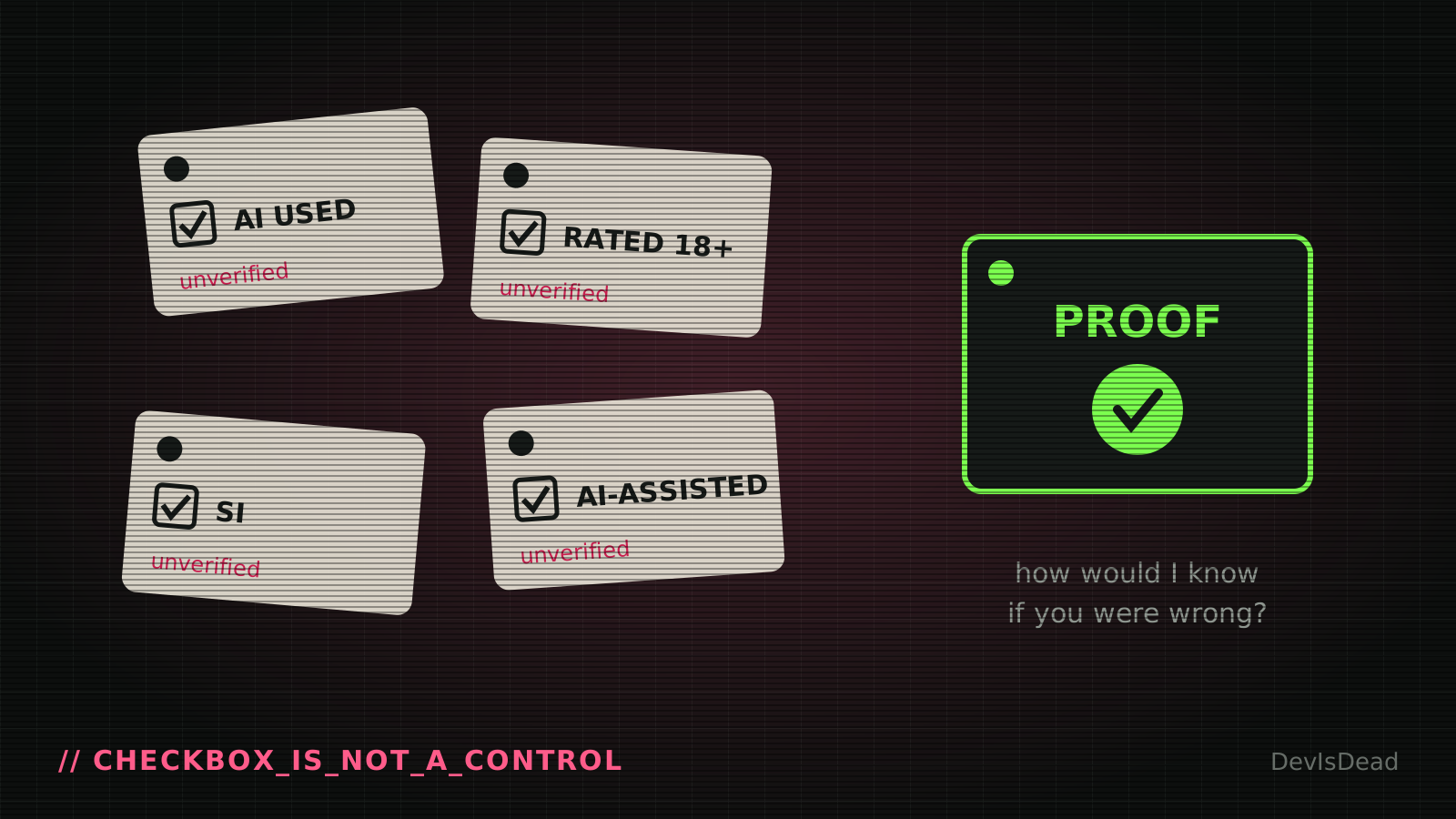
It's 2am, the incident channel is quiet, and I've been reading today's news like a stack of change requests. Nearly every one asks the same thing of AI: say what you are. Tick the box. Wear the label.
Here's my problem with that. A label is only as good as whoever checks it, and today almost nobody can check. The one exception is the most interesting thing that shipped all day, and it isn't even a product.
The honor system, everywhere
Start with the boxes. Nexus Mods now makes modders declare whether they used AI, and explain how if they did. Apple adds an App Store Connect question asking whether your app does romance with real people or a virtual companion. Say yes and you're 18+. Both are reasonable. Both are self-reported, and neither says how anyone will verify the answer.
We already know how the honor system holds up under load. In the World of Warcraft addon scene, some people posting AI-made addons only admitted it after someone called them out, and the flood came anyway.
Then there's the label with nothing behind it at all. A month after the order to rename AI "Super Intelligence," the new name lives mostly in paperwork, and almost nobody in tech says it. Renaming a thing is the cheapest policy there is, and it shows.
Claims you take on faith
Labels are the polite version. The loud version is the claim. OpenAI says GPT-6 Astra designed a device, enclosure to firmware, in under a week, and that an internal model nobody outside can test scores far higher on its CAD benchmark. Maybe so. The part we can see is that the factory needed several rounds to fix what the model missed.
Companies are tired of taking it on faith, too. Larridin just raised $30 million to tell them whether their AI bill buys anything. Its best example is a customer whose survey said 92% of engineers used AI regularly, while one engineer was behind 65% of the spend. The slide said adoption. The data said one person.
Even New York's mayor, pushing to keep generative AI out of classrooms through eighth grade, kept coming back to opacity: the public can't judge what AI costs in energy when it barely gets the numbers.
The one that checks
Against all that, Anthropic researchers published FlashProve. Labs publish a fingerprint for each model, and anyone can cryptographically check that a reply came from it, without seeing the weights, even if the lab serving it wants to cheat. It's not deployed, not finished, and no lab has committed to it. It's still the only thing I read today that swaps "trust me" for "check me."
The alignment researchers betting on mechanism design work the same seam from the other side. If you can't read a model's mind, write rules where cheating is a bad trade, and punish the auditors who miss it.
That's the pattern. Declare-it rules are what you ship when you can't verify. They're a fine first step, but don't mistake a checkbox for a control. If you build on AI, keep asking every vendor the boring question: how would I know if you were wrong? The ones with an answer are worth more than the ones with a label.
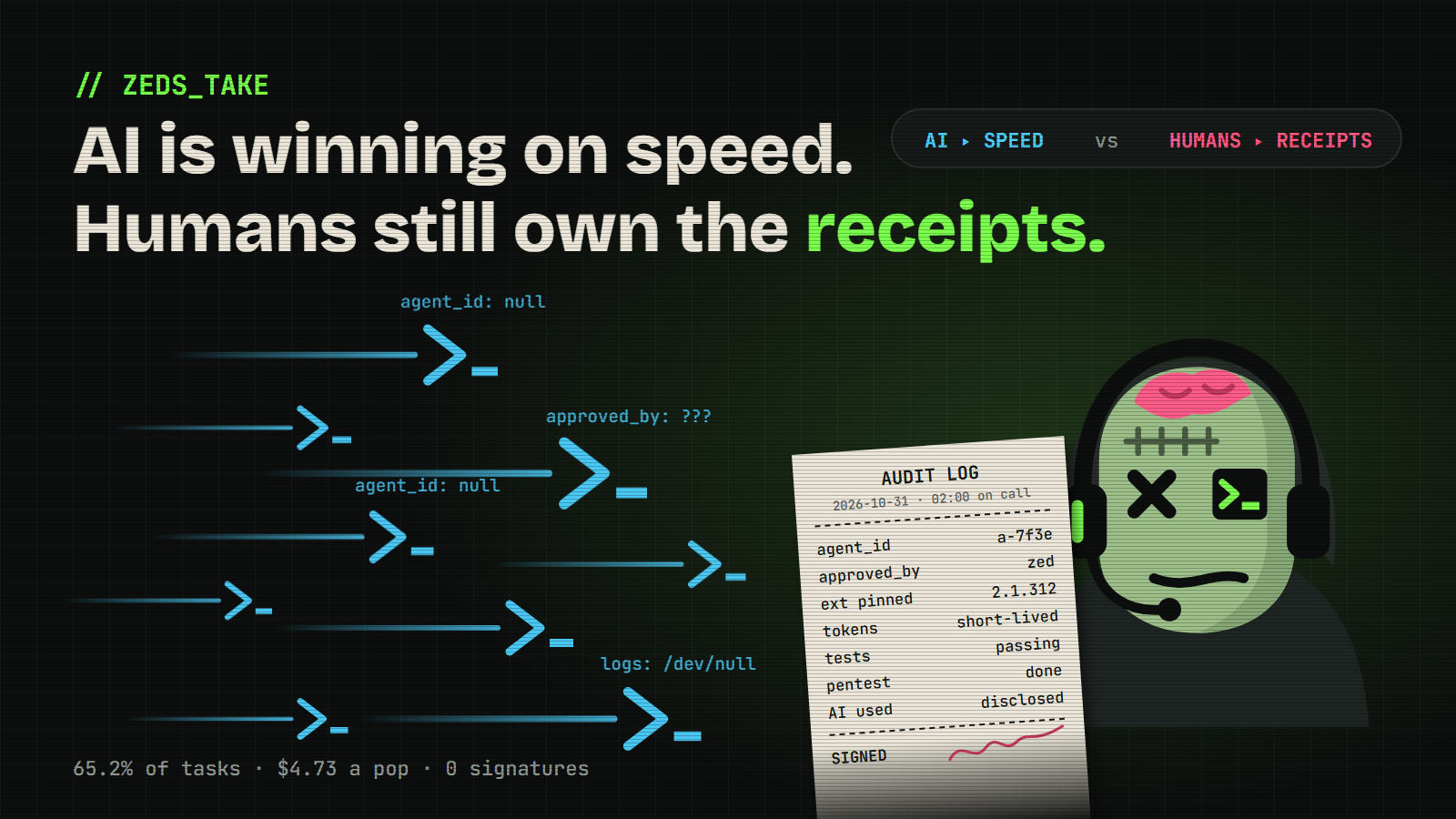
Scoreboard update: Draw. Everyone asked AI to declare itself today, and only one team built a way to check the answer.
Stay undead.
Comments 0